
In this guide
Every other guide in this cluster assumes a corporation, because that's where most of the complexity (and most of TaxDesk's use) lives. This one steps back and covers the main structures a Canadian business might actually be — corporation, partnership, trust, sole proprietorship — and where a "holding company" fits, since it comes up constantly but isn't really its own category.
From guidance to operating record
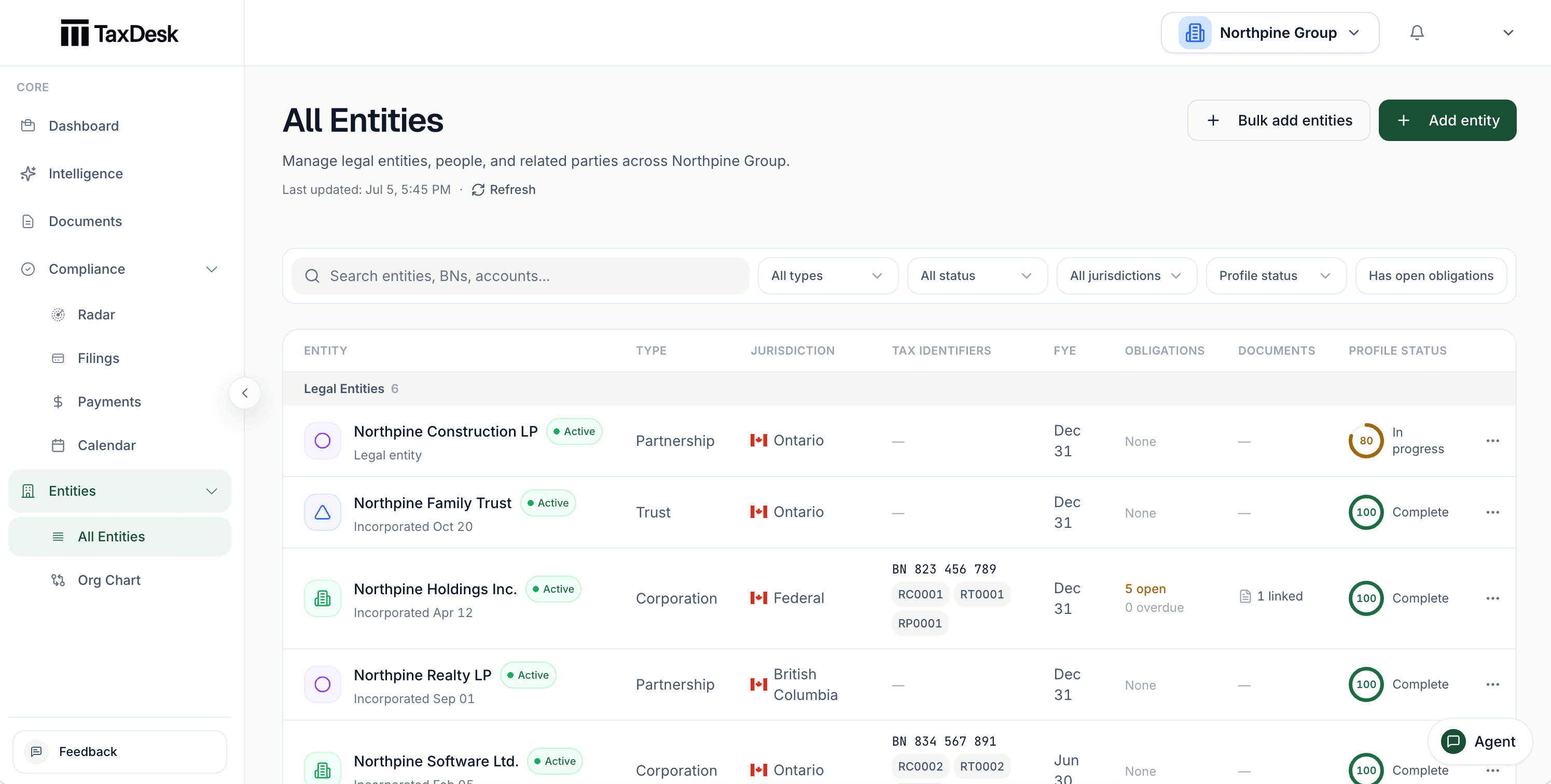
One workspace, whatever the mix of entities
TaxDesk supports corporations, trusts and partnerships side by side, so a group that mixes entity types doesn't need a different tool for each one.
- Type-specific profiles for corporations, trusts, partnerships and individuals
- Tax-program registrations and filing rules kept with the entity they belong to
- One searchable inventory across the full group
1. Corporations
A corporation is a separate legal person, distinct from its shareholders — it files its own T2, pays its own tax at corporate rates, and its shareholders are only taxed when the corporation pays them something (a salary, a dividend). Canadian-controlled private corporations (CCPCs) get preferential treatment on active business income up to a limit through the small business deduction. This is the structure the rest of this cluster is written around.
2. Professional corporations
A corporation used to carry on a regulated profession — law, medicine, accounting and others, depending on the province. It's taxed the same way as any other corporation, but it operates under rules set by the relevant professional regulator, which can restrict who's allowed to hold shares and how the corporation can be structured. The tax obligations don't change; the ownership rules layered on top do.
3. Partnerships
A partnership isn't a separate taxpayer — income and losses flow through to the partners, who report their share on their own returns, taxed at whatever rate applies to that partner (personal or corporate). The partnership itself may still need to file an information return depending on its size and the type of partners involved. Partners typically share liability for the partnership's obligations, which is part of why some businesses use a corporation as a partner instead of an individual.
4. Trusts
A trust holds property for beneficiaries under the terms set by a trustee, and files its own T3 return. Depending on how it's structured, a trust can flow income out to beneficiaries (who are then taxed on it) or retain and pay tax on it directly, often at a flat top rate. Trusts show up in corporate groups most often holding shares of an operating company — as part of an estate freeze, for income splitting among family members, or to hold shares for a future sale.
5. Sole proprietorships
The simplest structure: the business isn't a separate legal entity at all. Income and losses go directly on the owner's personal T1 return, taxed at personal rates, and the owner is personally liable for the business's obligations. No separate corporate filing exists because there's no separate corporation — the "obligations" are the owner's personal tax obligations, just with business income included.
6. “Holding company” isn't a legal entity type
Worth calling out on its own, because it trips people up constantly: a "holding company" isn't a distinct legal category the way a corporation, partnership or trust is. It's an ordinary corporation — incorporated and taxed exactly like any other — that's simply being used to hold shares, investments or other assets rather than to run an active business day to day. A holdco and an opco file the same kind of return under the same rules; what differs is their activity, their obligations (a holdco often has no payroll account, for instance), and how they fit into the group's ownership structure.
7. Non-profit organizations, briefly
A non-profit organization can be incorporated or unincorporated, and if it meets the conditions to qualify, its income is generally exempt from tax — though it may still have filing obligations depending on its size and activities. This is a distinct area with its own rules, and worth mentioning only because it's easy to lump in with "corporation" when it's really governed separately.
8. How obligations differ by entity
The return that gets filed, the rates that apply, and even the tax programs that apply all depend on which of these a given entity is. A corporation might carry RC, RT, RP and other accounts; a trust files T3s and issues its own slips; a partnership files an information return but no tax return of its own. See the corporate tax obligations guide for the full breakdown as it applies to corporations specifically.
9. How entities interact within a group
Real corporate groups are rarely one entity type. A common structure: a holdco (corporation) owns an opco (corporation), a family trust holds shares of the holdco for succession purposes, and a professional corporation bills the group for services. Each entity keeps its own filing obligations — nothing about being part of a group consolidates them into one return — which is exactly why keeping track across the whole structure takes deliberate organization. See how to organize tax across a multi-entity group.
Scope note. This guide is a general overview of entity types, not advice on which structure suits a particular business. Choosing or changing a business structure should involve a lawyer and accountant familiar with the specific facts.
Primary reading
Official starting points used to develop and check this guide.
Continue the workflow
The next useful step
Put the guide into practice
One workspace, whatever the mix of entities
TaxDesk supports corporations, trusts and partnerships side by side, so a group that mixes entity types doesn't need a different tool for each one.