
In this guide
CDA, GRIP and RDTOH show up in a lot of conversations as if everyone already knows what they mean. Often the accountant does and the owner doesn't, which is fine until a dividend decision depends on it. This guide explains each balance in plain terms — not the full legislative mechanics, just enough to know what you're looking at and why the number matters. For how these connect to the corporation's broader obligations, see the corporate tax obligations guide.
From guidance to operating record
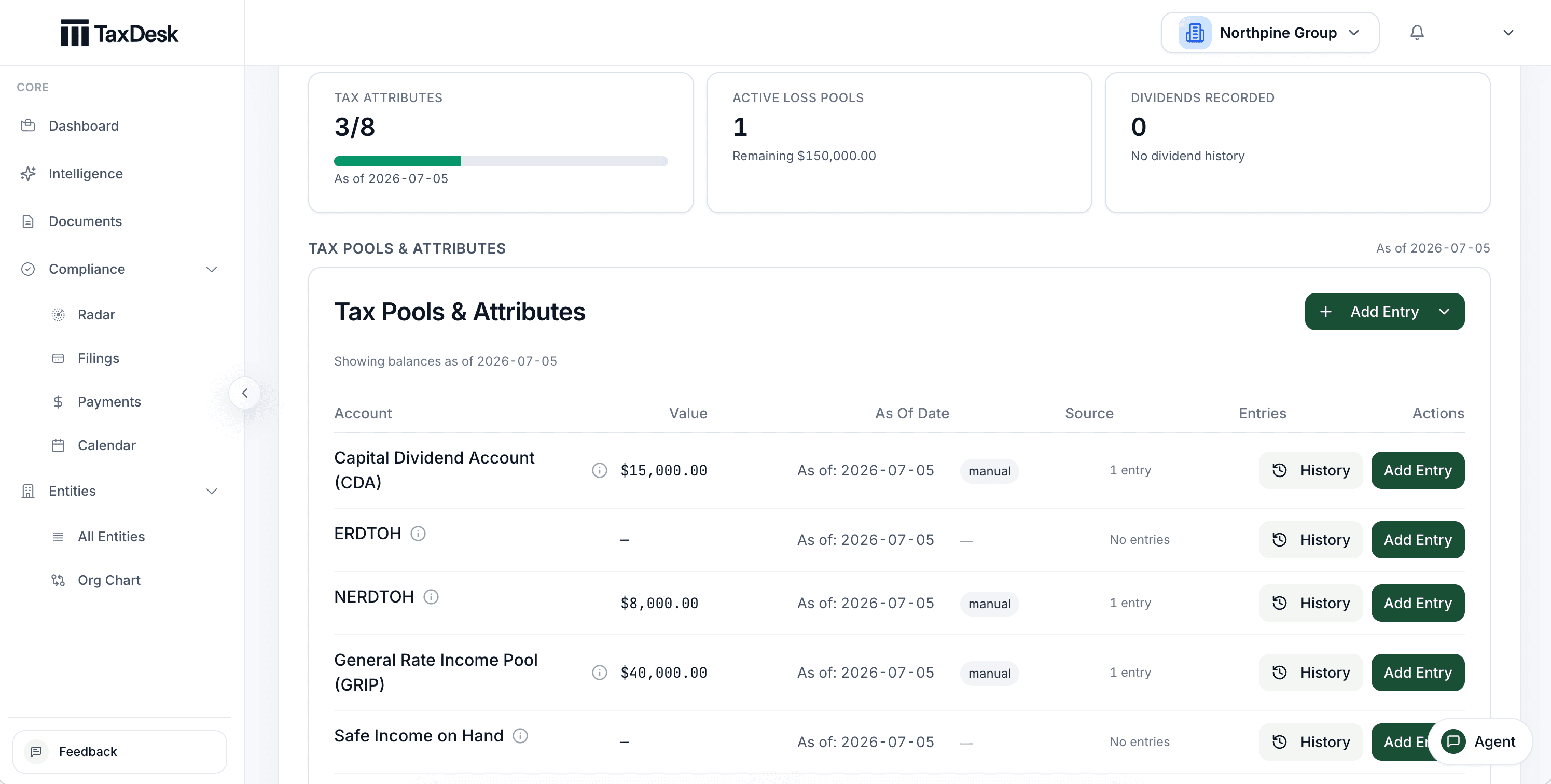
Attach the source to the balance
TaxDesk keeps tax attributes tied to the transactions and filings that created them, with a date, so a balance is never just a number someone remembers.
- Ledger entries preserve each increase, decrease and adjustment
- As-of balances are calculated from dated history
- Supporting filings and documents stay connected to the record
1. What a tax attribute actually is
A tax attribute is a balance the Income Tax Act tracks for a corporation outside of its regular income for the year — something that carries forward, gets drawn down, and changes what a future transaction costs in tax. CDA, GRIP, RDTOH, and the various loss pools are the most common ones for a private corporation. None of them appear as a single line on a T2 that just tells you "the answer" — each is built from a history of transactions, which is exactly why they're easy to lose track of.
2. Why they accumulate over time
Unlike income, which resets to zero every fiscal year, these balances persist — additions in one year sit on top of what was already there, and reductions draw the balance down rather than closing it out. A CDA balance from a capital gain five years ago is still there today unless a capital dividend has been paid against it since. That's the whole point of tracking them separately: they represent value the corporation (and its shareholders) are entitled to access on more favourable terms, and that entitlement doesn't expire just because a year ended.
3. The capital dividend account (CDA)
The CDA is a notional account — it doesn't sit in a bank, and it isn't on the balance sheet — that tracks the non-taxable portion of a private corporation's capital gains, net of the non-deductible portion of its capital losses, along with certain other tax-free amounts such as capital dividends received from other corporations. A positive CDA balance can be paid out to shareholders as a capital dividend, tax-free in their hands.
The trap is timing: the balance only exists once the actual gain has been realized and reported, and it's reduced the moment a capital dividend is paid against it — including one paid based on an estimate that turns out to be too high, which can trigger a penalty tax. The corporation needs to know its CDA balance at the moment of payment, not at the last year-end.
4. GRIP — the general rate income pool
GRIP tracks income that's already been taxed at the general corporate rate rather than the small business rate — broadly, active business income above the small business deduction limit, and certain other amounts. A positive GRIP balance lets the corporation designate dividends as "eligible," which are taxed more favourably in the shareholder's hands than ordinary (non-eligible) dividends, reflecting the higher corporate tax already paid on that income. Pay an eligible dividend beyond the available GRIP and the excess carries a penalty tax — so, like CDA, the balance needs to be current at the time of payment, not estimated from an old return.
5. Eligible and non-eligible RDTOH
Refundable dividend tax on hand exists because part of the tax a private corporation pays on investment income (and, historically, on some other income) is refundable once the corporation pays out taxable dividends. It's split into two pools that don't mix:
Eligible RDTOH (ERDTOH)
Builds mainly from Part IV tax on eligible dividends received from other corporations, and gets refunded when the corporation pays eligible dividends.
Non-eligible RDTOH (NERDTOH)
Builds mainly from the refundable portion of tax on investment income and non-eligible dividends received, and gets refunded when the corporation pays non-eligible dividends.
The dividend refund itself is calculated against the dividends actually paid in the year, so the amount refunded depends on both the balance available and what gets paid out — it isn't automatic just because a balance exists.
6. Loss pools
Losses aren't one pool — they're several, and mixing them up is a common source of errors:
Non-capital losses
Business and property losses. Can offset most types of income, with defined carryback and carryforward periods.
Net capital losses
Can only offset taxable capital gains, not other income — but carry forward indefinitely.
Allowable business investment losses
A special category of capital loss on certain small business investments, deductible against any income for a limited period before reverting to an ordinary net capital loss.
Carryback and carryforward periods change from time to time — confirm current periods with your accountant rather than relying on a fixed number of years.
7. Why a balance needs a date and a source
"What's our CDA?" doesn't really have an answer without also asking "as of when, and based on what?" Every one of these balances moves with each transaction that touches it, so a number without a date is really just a number from some unspecified point in the past. And because the additions and reductions each trace back to a specific transaction — a capital gain, a dividend paid, a loss claimed — a defensible balance needs to point to the transactions that built it, not just state a total.
8. Why last year's T2 may not show the current position
A T2 reports the balance as of that fiscal year-end. Anything that's happened since — a dividend paid, a gain realized, a loss claimed elsewhere in the group — has moved the number, and the return won't reflect it until it's filed again next year. Treating the most recent T2 as "the current balance" is one of the most common ways these numbers end up wrong in a live decision.
9. What records support each balance
At minimum: the transaction that created the addition (the sale agreement behind a capital gain, the T2 schedule showing income taxed at the general rate), the calculation showing the running balance, and a record of every dividend or loss claim that drew it down since. See what belongs in a corporation's tax file for how to keep this organized alongside everything else.
Scope note. This guide explains these balances at a conceptual level and isn't a substitute for a calculation. CDA, GRIP and RDTOH amounts, and loss carryforward rules, should be confirmed by your accountant against the corporation's actual filing history before any dividend or loss claim relies on them.
Primary reading
Official starting points used to develop and check this guide.
Continue the workflow
The next useful step
Put the guide into practice
Attach the source to the balance
TaxDesk keeps tax attributes tied to the transactions and filings that created them, with a date, so a balance is never just a number someone remembers.