
In this guide
A shareholder loan and an intercompany loan often get recorded the same way in the books — a balance in a due-to or due-from account, moved without much ceremony. They're treated very differently under the Income Tax Act, and confusing the two is one of the more common ways a related-party transaction turns into an unwelcome surprise at reassessment. This guide covers the difference at a level that should help you ask the right questions; the specifics of any real loan belong with your accountant.
From guidance to operating record
Reconcile every intercompany balance in one place
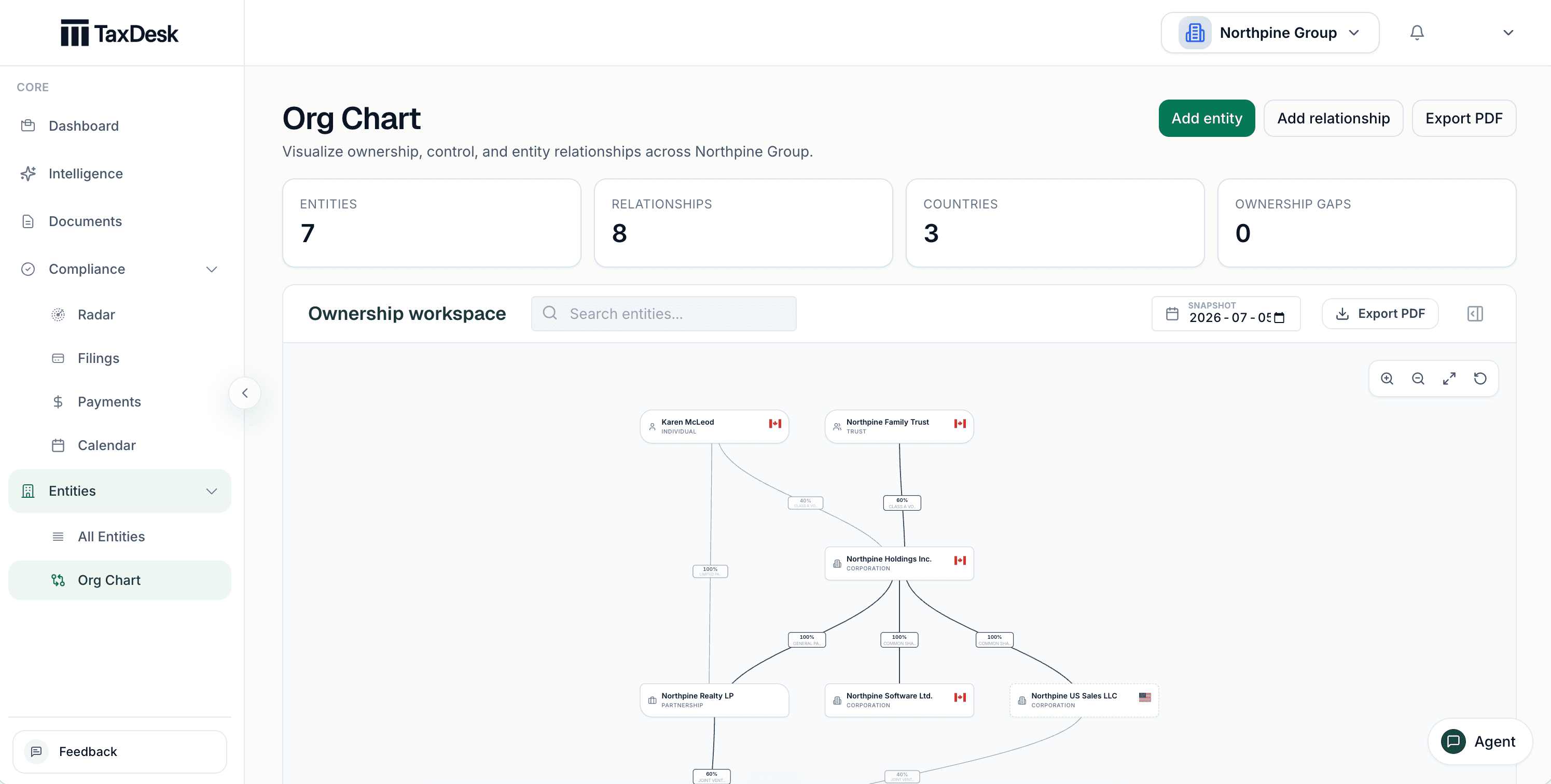
TaxDesk keeps loan agreements, ledger balances and repayment history attached to both entities on a loan, so a reconciliation isn't a special project every year-end.
- Related entities and ownership details visible beside the record
- Agreements and supporting documents attached to the right entities
- Dated history makes year-end reconciliation reviewable
1. Two different things, one name
A shareholder loan runs between a corporation and one of its shareholders (or someone connected to a shareholder) personally. An intercompany loan runs between two corporations that are related or affiliated — say, a holdco and its opco. Both often get called "the shareholder loan account" informally, especially in a simple holdco/opco structure where the same person is behind both entities, but the tax rules that apply depend on which one it actually is.
2. Why the classification matters
A loan to an individual shareholder can be swept into that shareholder's income under subsection 15(2) if it isn't repaid in time. A loan between two corporations doesn't fall under that rule at all — it's governed by ordinary debt and, where relevant, transfer-pricing and related-party rules instead. Treating an intercompany loan as though it were a shareholder loan (or the reverse) means applying the wrong set of rules to the wrong transaction.
3. Subsection 15(2), at a high level
In broad terms, subsection 15(2) says that if a corporation lends money to a shareholder (or certain people connected to a shareholder) and the loan isn't repaid within a set window, the outstanding amount gets added to that person's income for the year the loan was made — not treated as a loan for tax purposes at all. There are exceptions built into the rules for things like loans made in the ordinary course of a corporation's regular lending business, and certain loans to employee-shareholders for specific purposes such as buying a home, made under normal commercial terms.
The practical takeaway: a loan to a shareholder is not automatically safe just because the intention is to repay it eventually. The timing, the terms, and whether it fits an exception all matter, and they need to be checked against the specific facts — this guide is not a substitute for that check.
4. Interest and documentation
A loan without a written agreement, a stated interest rate, and defined repayment terms looks a lot like a benefit conferred on the shareholder rather than a genuine loan — which brings a different set of income-inclusion rules into play. At minimum, a real loan should have a signed agreement, an interest rate that can be justified as commercially reasonable (or explicitly at the prescribed rate, where that's the intention), and a record of interest actually being charged and paid, not just accrued on paper.
5. Repayments and circular transactions
A loan that gets repaid right before it would otherwise be included in income, then re-advanced shortly after, is exactly the pattern the rules are designed to catch — a "series of loans and repayments" can be treated as if the original loan was never repaid at all. Genuine repayments, made with real funds and not immediately reversed, are what actually satisfies the requirement.
6. Reconciling between entities
For an intercompany loan, one entity's books should show a receivable that matches the other entity's payable, to the dollar, at any given point in time. In practice these drift — an interest accrual posted on one side but not the other, a repayment recorded in the wrong period — and the gap usually isn't caught until someone goes looking for it at year-end. A running reconciliation between both entities' ledgers is the only way to catch this before it compounds.
7. Why the paperwork, the ledger and the filing need to agree
The loan agreement describes what was supposed to happen. The general ledger describes what the books say happened. The tax return describes what was reported to CRA. When all three tell the same story, a loan is straightforward to defend. When they drift apart — an agreement that says one interest rate while the ledger accrues another, or a repayment that shows up in the books but not in the loan schedule — that gap is exactly what an audit tends to find first. See what belongs in a corporation's tax file for how to keep the three in sync.
Scope note. This is a general, plain-English explanation and not a substitute for advice on a specific loan. Subsection 15(2) and its exceptions are technical and fact-dependent — have any shareholder or intercompany loan reviewed by a qualified advisor before relying on a particular tax treatment.
Primary reading
Official starting points used to develop and check this guide.
Continue the workflow
The next useful step
Put the guide into practice
Reconcile every intercompany balance in one place
TaxDesk keeps loan agreements, ledger balances and repayment history attached to both entities on a loan, so a reconciliation isn't a special project every year-end.