
In this guide
"The tax file" sounds like one thing. In practice it's usually several — a folder with the accountant, a drawer with the lawyer, a shared drive somewhere, and whatever's attached to old emails. None of that is wrong, exactly, but it means nobody can actually answer "do we have this?" without checking three places. This guide lays out what a complete file looks like, so you at least know what you're missing. It pairs with the corporate tax obligations guide, which covers what triggers each of these documents in the first place.
From guidance to operating record
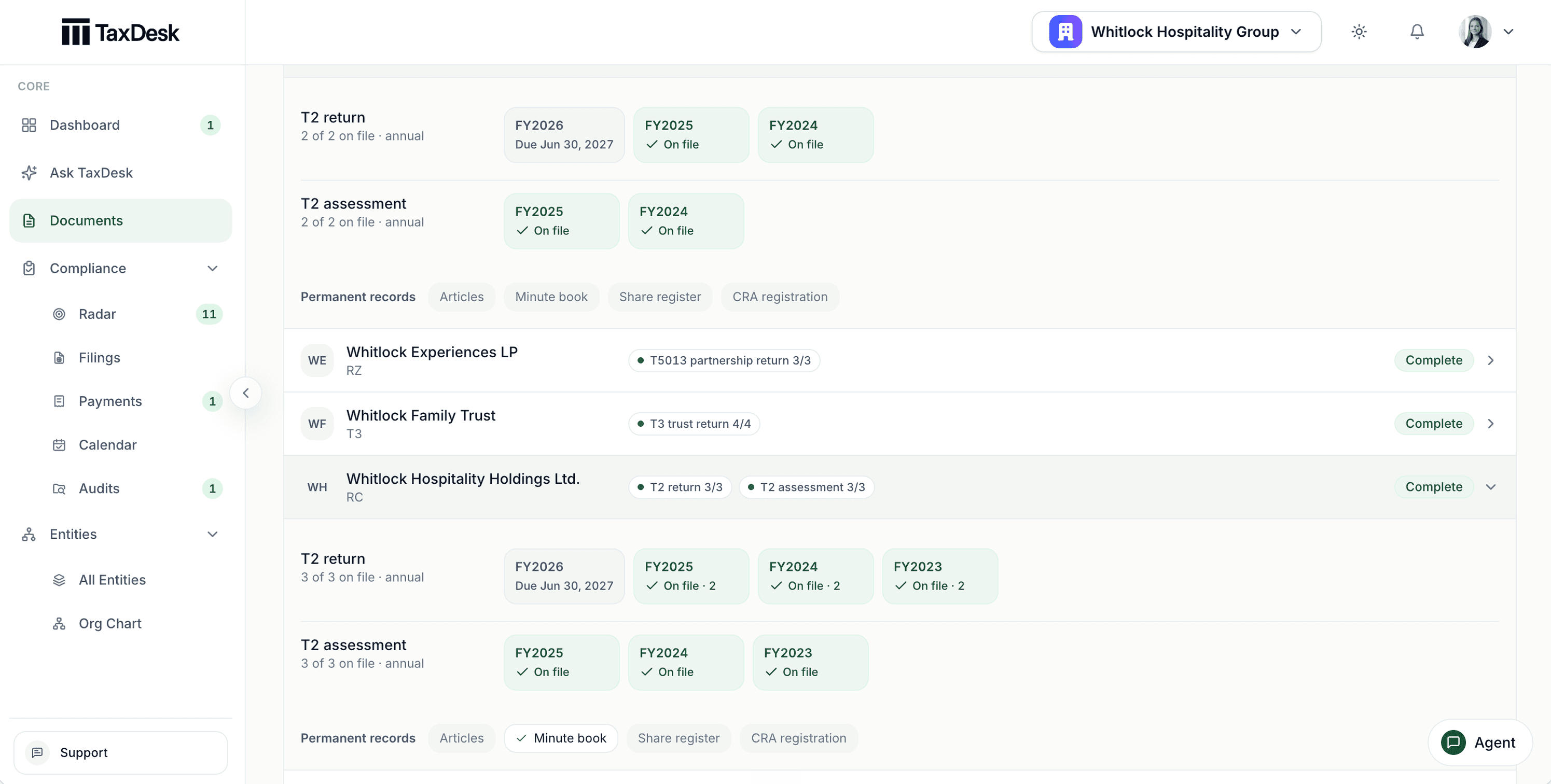
Store the file where the obligation lives
TaxDesk attaches documents directly to the entity, account and period they support, so 'do we have this?' has one answer instead of three.
- Documents linked to the relevant entity and obligation
- Tax year, document type, and extracted facts kept together
- Source evidence stays available during review and handoff
1. Permanent records vs. annual records
The first useful split isn't by document type — it's by how long the thing matters. Some records are relevant for exactly one filing period and can be archived once that period closes. Others describe something about the corporation that stays true indefinitely, or until it's formally changed.
Permanent
Articles of incorporation, share registers, standing elections, loan agreements still in force, accounting policy choices — anything that stays true until someone actively changes it.
Annual / period-specific
A given year's T2, its schedules, that year's NOA, that year's GST/HST returns — tied to one fiscal period and largely done once filed and assessed.
Treating everything as "this year's stuff" is how permanent documents go missing — nobody re-files the articles of incorporation every year, so if it isn't stored somewhere easy to find, it eventually isn't stored anywhere.
2. Returns, elections and notices
The core of any tax file. Filed returns and their schedules, any elections filed alongside or separately from a return, and the notices CRA sends back in response. Elections are the easiest of these to lose track of — they're often filed once, years ago, and nothing about day-to-day operations reminds anyone they exist.
3. Ownership and legal documents
Share registers, director and officer resolutions, share subscription and transfer documents, shareholder agreements, and the corporation's constating documents. These sit closer to corporate law than tax, but tax treatment routinely depends on them — a dividend, a share transfer or a change of control all need to be checked against what the ownership records actually say happened.
See why ownership and share-class records matter for tax for more on this.
4. What backs up a tax attribute
Balances like CDA, GRIP and RDTOH aren't self-evident from the current T2 — they're running totals built up over years of transactions. The support for each one needs to trace back further than "the software says the balance is X": the capital gain that created a CDA addition, the dividend that drew it down, the tax paid at the general rate that built GRIP.
The full mechanics are in the plain-English guide to CDA, GRIP, RDTOH and losses.
5. Intercompany documentation
Loan agreements between related corporations, management fee arrangements, cost-sharing agreements, and the reconciliations tying one entity's payable to another's receivable. This is the category most likely to be incomplete, because intercompany transactions often start as a bookkeeping entry with the paperwork meant to follow "later."
More on this in shareholder and intercompany loans in Canada.
6. CRA correspondence
Every notice, letter and request the CRA has sent — not just the ones that required a response. Statements of account and instalment reminders feel disposable in the moment but are useful later for reconstructing what CRA believed about the account at a given point in time, especially if a dispute comes up.
7. Advisor deliverables
Working papers, tax memos, reconciliations and planning documents from accountants and lawyers. These often contain the reasoning behind a position — why a transaction was structured a certain way, why a balance was calculated a certain way — that the filed return itself doesn't show. Losing this is what makes "reconstructing history years later" (see the obligations guide) so painful in practice.
8. Organizing it: entity, period and document type
For a single corporation, a folder-per-year with subfolders for each category above works fine. It stops working the moment there's more than one entity — a document that's actually about the parent gets filed under the subsidiary, or vice versa, and nobody notices until it matters.
That's also the structure that carries over cleanly into organizing tax across a multi-entity group .
Scope note. This guide describes a practical recordkeeping structure, not a legal retention schedule. Retention periods vary by document type and circumstance — confirm specifics with your accountant.
Primary reading
Official starting points used to develop and check this guide.
Continue the workflow
The next useful step
Put the guide into practice
Store the file where the obligation lives
TaxDesk attaches documents directly to the entity, account and period they support, so 'do we have this?' has one answer instead of three.