
In this guide
Most owners can describe who owns their company in a sentence. Fewer can point to the documents that actually establish it — the share register, the resolutions, the class terms — and fewer still keep those updated as the structure changes. Tax rules that depend on ownership don't run off the sentence; they run off the record. This guide covers what that record actually needs to contain.
From guidance to operating record
Keep the ownership record, not just the percentage
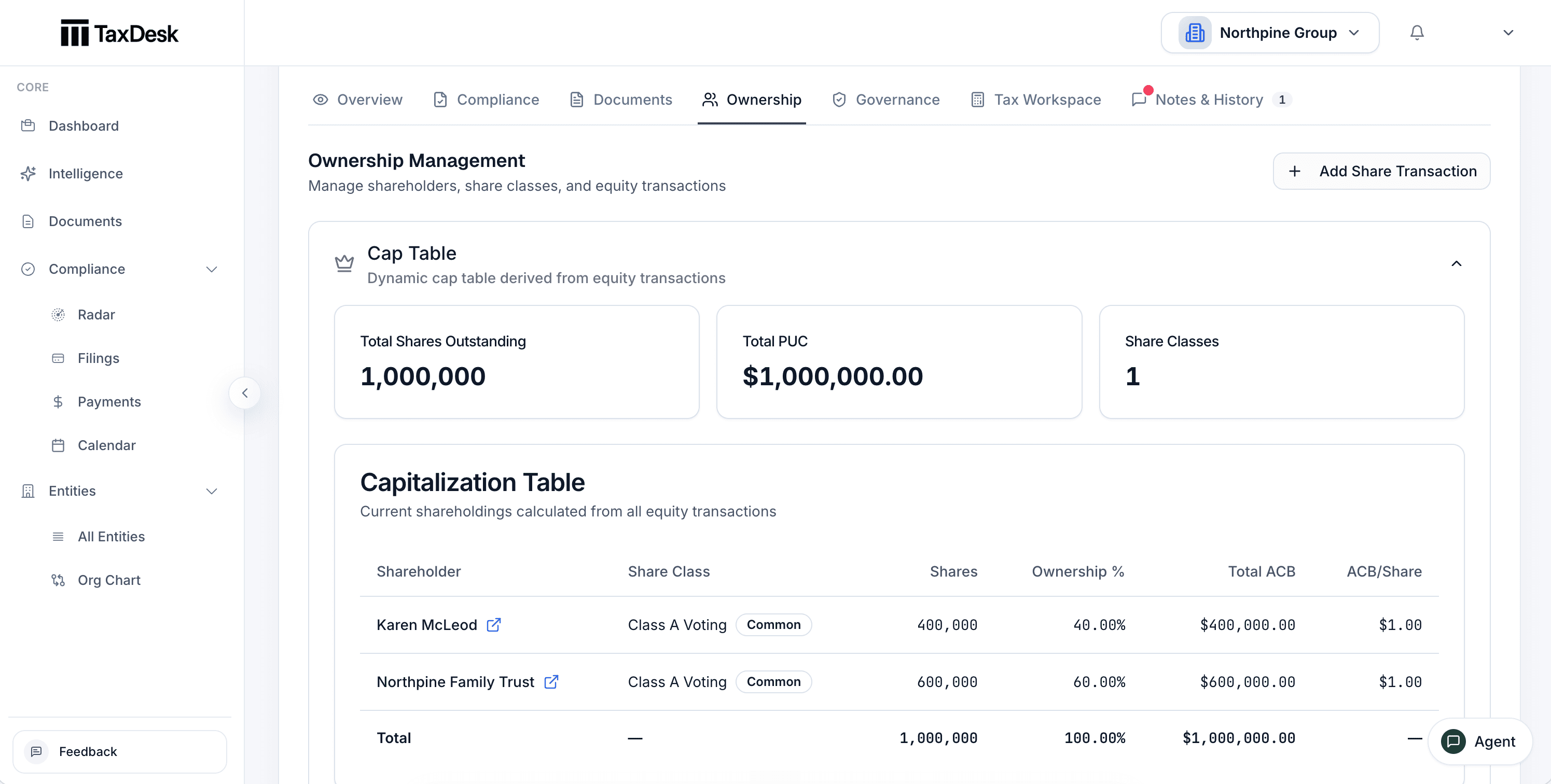
TaxDesk tracks share classes, ownership history and the documents behind them, so 'who owns what, and since when' has a documented answer.
- Share classes and their rights recorded explicitly
- Transactions preserve how ownership changed over time
- Ownership records connect the group instead of a static diagram
1. Legal ownership vs. beneficial ownership
The name on the share register is the legal owner. Who actually benefits from the shares — receives the dividends, bears the risk, calls the shots — is the beneficial owner, and it's not always the same person. Shares held in trust, held by a holding company on someone's behalf, or subject to a side agreement can all separate legal ownership from beneficial ownership. Tax rules sometimes look past the legal owner to the beneficial one, so a record that only shows the register misses half the half the answer.
2. Voting and value are different questions
Owning shares that control the company (voting) and owning shares that represent most of its worth (value) aren't the same thing, and a share structure can deliberately separate them — one person holds voting control with a small equity stake, another holds most of the value with no vote. Control for tax purposes is usually about votes, not value, which matters for questions like whether two corporations are associated or under common control.
4. Paid-up capital and adjusted cost base aren't the same number
Paid-up capital (PUC) is a tax concept tracked per share class, broadly reflecting what was contributed to the corporation for those shares — and it's what determines how much can be returned to a shareholder tax-free. Adjusted cost base (ACB) is what a particular shareholder paid for their shares, tracked per shareholder rather than per class. The two start out related but diverge over time as shares change hands, get bought back, or the corporation does a reorganization. Confusing them is a common source of errors when a shareholder eventually disposes of shares.
5. Dividends follow the share class
A dividend can be declared on one share class and not another, and different classes can receive different amounts even within the same corporation — that's often the entire purpose of having multiple classes. Getting this right depends on the share terms actually permitting it and the declaration being properly documented by class, not just paid out informally to whoever the money was meant for.
6. Associated-corporation implications
Whether two corporations are "associated" under the Income Tax Act depends on the ownership and control tests being applied to the actual share structure — including who controls each corporation, and specific rules about related and connected persons. Associated corporations share a single small business deduction limit between them, which needs to be allocated. Getting the ownership record wrong can mean getting the associated-corporation determination wrong, and getting that wrong affects every associated entity's tax bill, not just one.
7. Changes of control
An acquisition of control — a new majority shareholder, a share sale, certain trust or estate events — can trigger a deemed year-end and restrict how the corporation's loss pools can be used going forward. None of that can be evaluated without a precise record of exactly when control changed and who held it before and after. "Sometime last year" isn't precise enough when the deemed year-end itself depends on the exact date.
8. Reorganizations
Share exchanges, estate freezes, amalgamations and other reorganizations all depend on the ownership and share-class position immediately before the transaction. Without a clean record of what the structure looked like going in, it's difficult to confirm afterward that a reorganization achieved what it was intended to — or to explain it to a future advisor who wasn't involved in the original planning.
9. Why a percentage-only org chart isn't enough
A chart that shows "Holdco owns 100% of Opco" is a reasonable starting point and a poor ending point. It doesn't show which share class, what that class's voting and dividend rights are, what the PUC and ACB are, or when the structure last changed. See how to organize tax across a multi-entity group for how ownership records help keep a group organized.
Scope note. This guide explains why ownership records matter for tax purposes; it isn't a substitute for corporate-law or tax advice on a specific share structure, reorganization or change of control.
Primary reading
Official starting points used to develop and check this guide.
Continue the workflow
The next useful step
Put the guide into practice
Keep the ownership record, not just the percentage
TaxDesk tracks share classes, ownership history and the documents behind them, so 'who owns what, and since when' has a documented answer.